
For three months I have read Upwork job posts every day. I look for Product Manager and Product Owner work, so I read a lot of them.
What I see in the job posts
Fewer of them ask for a Product Manager. More of them ask for someone else:
- Head of Growth
- Growth Strategist
- Monetization Specialist
- Business Developer
- Social Media Content & Engagement Specialist
Different titles, one request: someone who will bring users.
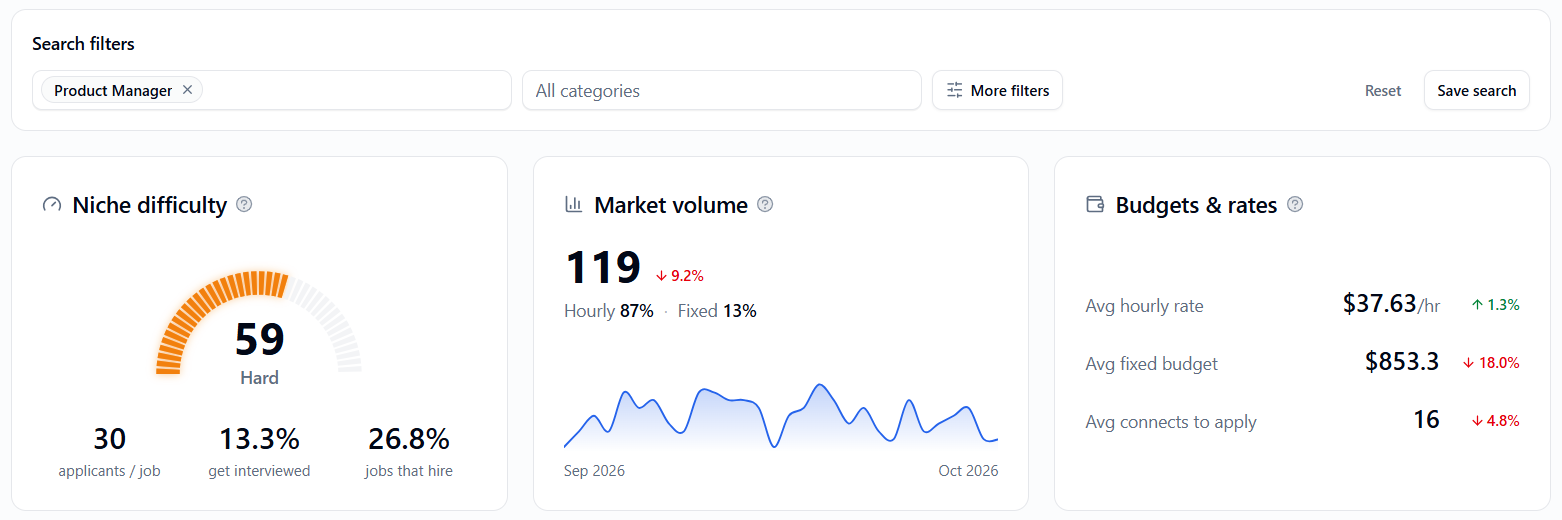
The numbers agree with my feeling only partly, so here they are. In the last 30 days, Upwork had 119 jobs for “Product Manager”, 9% fewer than in the 30 days before. Each one got about 30 proposals.

Roadmaps have not disappeared completely. “Product Roadmap” is still listed as a skill in about one in four of these posts. What surprised me is what sits next to it. In Product Manager posts, “Marketing Strategy” appears in 8.4%, “Internet Marketing” in 5%, and “Sales” in 5%. Some posts ask for someone to set up product analytics in Mixpanel or Amplitude.

The same tool shows which skills are growing inside these posts. The counts are small, so I would not call it a trend yet. But they point the same way as my feeling. Compared with the 30 days before, “Data Analysis” went from 4 posts to 8, “Business Analysis” from 5 to 9, and “Marketing Strategy” from 8 to 10. “Jira” went from 9 to 5.

Sometimes it feels as if every product is already built and perfect, and the only missing piece is a person who knows the magic.
Why this makes sense
I understand where it comes from. Building got cheap. With AI, a founder can ship a working product in weeks, sometimes alone. A few years ago, that took a team and a budget.
You can see it in the job posts too. In the same 30 days, about 1,100 Upwork posts mentioned n8n, another 1,100 mentioned Zapier, and 274 mentioned Lovable: tools for building and automating without a full development team. 363 mentioned a product roadmap.
The first hard problem used to be “can we build it?”. Now it is “will anyone use it?”. And that looks like a traffic problem.
Sometimes it is one. If nobody knows a product exists, no amount of product work will fix that. Growth people are needed, and good ones are rare.
But it is not always the case.
The other side
I once joined a product that was full of bugs. Most of the conversations around it were about marketing and promotion. Traffic was being paid for. The product was not ready to keep it.
Nobody was doing anything foolish. Promotion is visible: you can see the ads, the clicks, the spend. Bugs are quiet. A user who hits one usually does not complain. They just leave, and in the numbers they look exactly like a user who was never interested.
My own work there started with the bugs: logging them, and rewriting the stories so the product behaved one way.
The users they already have
Since then, when I read “we need someone to bring users”, I think about the users they already have.
Some signed up and never came back. Some started the set-up and stopped on step two. Some reached the main screen and did not understand what to do next. Some found the thing they came for, and it did not work.
Each of these people already cost money to bring in. Each of them left before they found the reason the product exists. More traffic does not change where they stop. It just sends more people to the same place.
Where exactly they stop is not a growth question. It is a product one.
What I look at first
When a product “needs growth”, these are the first things I look at:
- The path to the result (how fast and how easily a new user gets to the “aha” moment). What does a new user have to do to get what the product promises? How many steps is that, in reality?
- Where people stop on that path. With analytics, this shows in a funnel. Without it, it shows in the database, in support messages, and in a few slow walk-throughs of the product.
- What happens when something goes wrong on that path. An error, an empty screen, a bug, a message that explains nothing.
- What “an active user” means to the team. If three people give three answers, the numbers will not settle it.
None of this replaces growth. It decides whether the money spent on growth stays in the product or leaks out of it.
That is also why the analytics requests in PM job posts make sense to me. You cannot see where users stop if nobody is measuring it.
And measuring has traps of its own. In a recent onboarding audit, the founder prepared new accounts by hand, so the usual activation number would have counted his work as the customers’ progress. I wrote about that case in The founder is inside your funnel.
Not magic
I don’t think the products in those job posts need magic. Many of them need someone to look at what happens after the sign-up. Sometimes that person is a growth hire. Often it is someone on the product side.
I will keep reading the job posts. I suspect the titles will keep changing faster than the problems.
If you want a second pair of eyes on where new users stop in your product, I do this as a fixed-scope onboarding audit: link .
Soon I will share the checklist I use for it.
**Numbers: Vollna Market Insights (a tool I use to filter Upwork jobs), search “Product Manager”, all of Upwork, 30 days to 5 October 2026. Skill changes = Vollna “Skill momentum” for the same search; earlier counts calculated back from its percentages. Keyword counts (n8n, Zapier, Lovable, product roadmap) cover all Upwork posts that mention the word, not only Product Manager posts.


Leave a Reply