
For most of my career, my best work looked like nothing happening.
That sounds like false modesty. No, it is not.
Product work is not directly physical – you won’t pick up a finished part when the work is done.
This work is mostly invisible by design.
Actually many intellectual jobs can be perceived as invisible ones – “They ‘re just sitting there and warming chairs. But I’m not about them all, I’m talking specifically about Product Owner / Product Manager job.
Reduce the chaos. Specify and clarify. Stop the team from building the wrong thing. Translate various business wishes into a plan someone can actually act on. Hold the context nobody else is holding. Ask the uncomfortable question early — while it’s still cheap to ask. Is it real work? Real value?
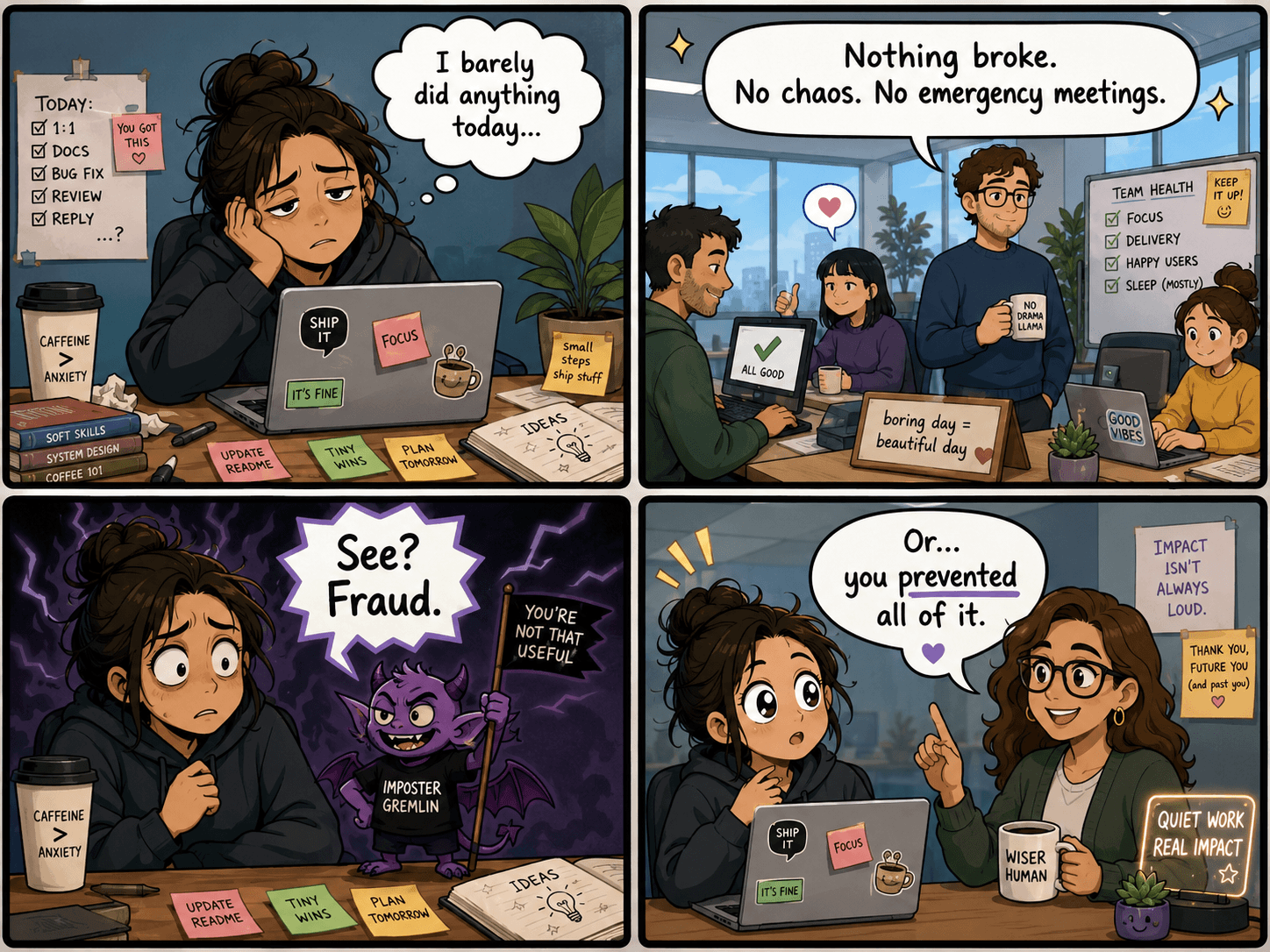
And when you do all of that well, here’s the result — nothing breaks. No drama. No damage. No stress. Which your brain quietly reads as: I did nothing.

This is why (I guess) an imposter syndrome lives so comfortably in Product roles. The job is partly prevention — and prevention is not visible or noticeable by definition. A wrong decision that never happened leaves no trace ( I remember when I heard about survivorship bias for the first time and I was deeply impressed).
Good preventive work looks exactly like the absence of work. And you sit in a standup, watching things go smoothly, and some part of you whispers that you’re getting paid for air.
I carried that feeling for years.
Recently I finished a small one-off project — a review of a product’s customer journey. End to end, from a cold visitor to a real decision point. And I hadn’t enjoyed work that much in a long time. The product itself was thoughtful. The way it was put together, the way the journey was structured — I kept noticing decisions made by someone who clearly cared.
For a few days while I worked on it, I felt passionate, excited and grounded. Useful. Like I was doing something real.
I tried to understand why this one felt different.
Here, my judgment was visible. The whole deliverable was judgment. Every finding I wrote down was the product of the work — not a quiet thing that happened in the background and disappeared. And the invisible part of the job had a shape.
So, after this notice I think, that the cure for imposter syndrome is not someone telling you that you did well. The cure is when your own judgments are visible to you.
But this cure is a bit fragile, because it’s impacted by having a project in front of you. When the work is done, the imposter’s thoughts can come back quickly.
If you do invisible work for a living — product, requirements, the quiet untangling of other people’s chaos — you may recognise this state. I don’t have a framework to make it disappear (actually my consistent gym training helps to keep this grounded feeling longer, heavy weights make me feel real).
But I’d offer one reminder to yourself: the silence after your work isn’t proof you did nothing. It’s the sound of the wrong thing not happening.

Leave a Reply